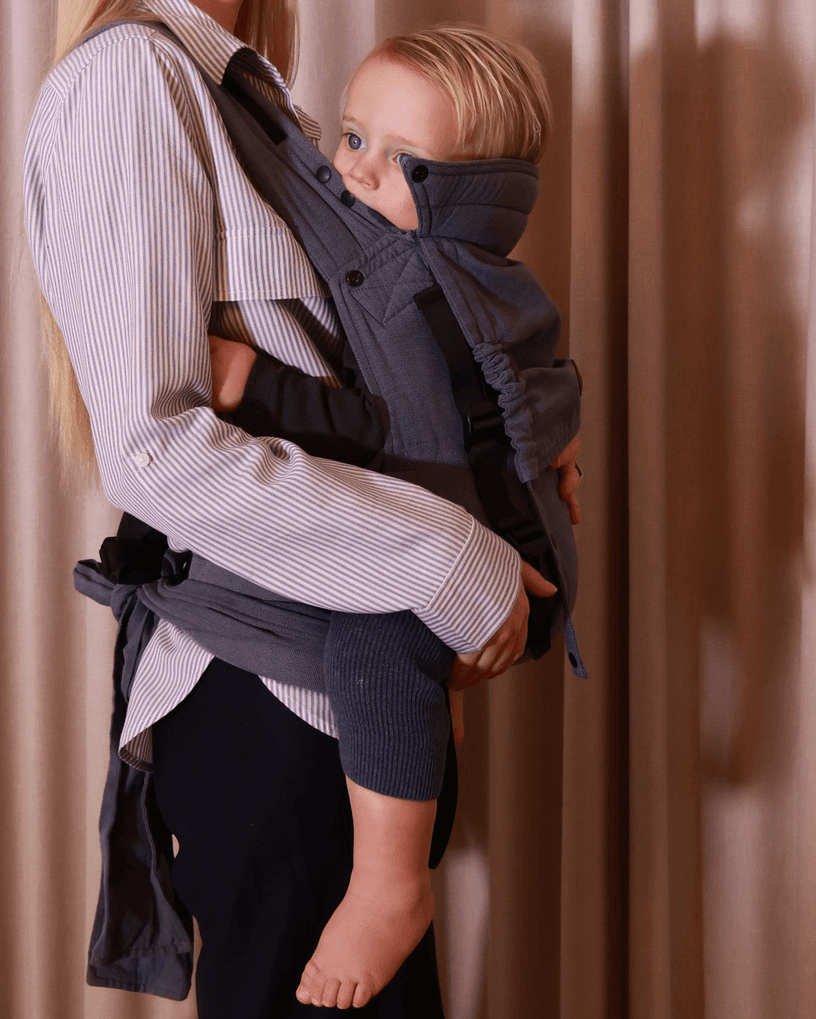
What makes Babue different isn't simply that it has a patented feature. It's that the entire carrier was designed around how force travels through the human body. That is a much bigger story.
Pressure
When people talk about baby carriers, they usually ask one question:
“How much weight can it hold?”
As an occupational therapist, I find myself asking a different question. Where is that weight going?
Because two carriers can hold exactly the same baby, yet feel completely different on your body. The difference isn't your baby's weight. The difference is how that weight is distributed.
Imagine someone pressing the pointed tip of a pen against your finger. It hurts almost immediately, doesn't it? Now turn the pen around and press the flat end against the very same finger using the same amount of force. Suddenly, it feels completely different.
Nothing changed except one thing. The pressure was spread over a larger surface.
Your body experiences a baby carrier in exactly the same way.
Weight is only half the story. Pressure is weight divided by the area supporting it. The more concentrated the load becomes, the harder your body has to work to tolerate it. Spread that same load over a larger area, and your body experiences it very differently.
This is one of the foundational principles behind every Babue carrier.
Your Body Feels Pressure Long Before It Feels Weight
Many parents tell us: "My baby isn't even that heavy, yet my shoulders ache, and I feel neck pain and tightening." By the end of the day, they cannot wait to take the carrier off.
Often, it isn't because their baby is too heavy. It is because too much of that weight is travelling through too little of the body.
Your nervous system is constantly monitoring pressure as well. It also notices when muscles are working harder than necessary. It notices when joints are overloaded. It notices when tissues are compressed for long periods. Your body is already making adjustments. You may find yourself shrugging your shoulders, leaning backwards, arching your back, gripping tighter, or shifting onto one hip.
These compensations are incredibly important as they help you keep going. But they also tell us something important. Your body is trying to spread the load because the carrier isn't doing enough of that work for you.
Why Shoulders Tire So Easily
The shoulder is an extraordinary joint. It allows you to reach overhead. Throw a ball. Lift your child. Brush your hair. Wrap your baby. Its gift is movement. But that freedom comes with a trade-off.
Unlike your hips, your shoulders were never designed to be your body's primary weight-bearing structure. They rely on relatively small muscles and soft tissues to suspend your arm from your torso.
Around the shoulder are several bony areas where there is very little natural cushioning. When pressure repeatedly concentrates over these areas, muscles begin working overtime. Soon the neck joins in. Then the upper back. Eventually your entire body begins compensating.
Again, the issue usually isn't your baby's weight. It's where that weight has been asked to travel.
Pressure Was One of the First Questions We Asked
When we began designing Babue, we didn't start by asking, "How can we make another baby carrier?" We asked, "How can we help the body experience carrying differently?"
Every design decision came back to pressure. Could we spread the load across more of the body? Could we invite larger muscle groups to participate? Could we reduce the amount of force travelling through the shoulders alone? Could we help the body carry with itself instead of fighting against gravity?
That thinking shaped everything that followed. The width of the straps. The waistband. The panel. The fabric. The way the carrier wraps around both parent and baby.
Even our patented Torso Support Strap begins with this same question: How can we help the body share the work?
Force Has to Go Somewhere
Gravity never disappears. Your baby's weight never disappears. A carrier doesn't remove weight. It simply decides where that weight will travel.
The 4 Babue Design Principles
Where does the force go?
Which body parts should receive that force?
How do we spread that force across the baby's body?
How do we create stability and security while doing it?